
This is usually the point where clients feel the most nervous — not because they don’t trust the process, but because the numbers are big, unclear, the system feels unfamiliar and somehow unfair.
So in this guide, I want to walk you through exactly:
- What you’ll be paying for
- How the taxes are calculated
- How to pay using the KRA eSlip
- And the small mistakes that can delay your car from being cleared
First — When Do You Pay Customs?
Customs duty is paid after your car arrives in Mombasa and has been assessed by the Kenya Revenue Authority(KRA).
Once that assessment is done, an official eSlip is generated and sent to you. You’ll often receive this via email or whatsapp from us.
That eSlip shows:
- The total amount to be paid
- A breakdown of all taxes
- A payment reference number
This is the document you’ll use to make the payment.
Until customs is paid, your car cannot be released.
Why Is My Tax This Amount?
You’ll probably ask yourself this.
I couldn’t agree more, it’s a fair question.
The amount on the eSlip isn’t random — it’s calculated using a system based on a value assigned to your vehicle by KRA.
That value is called the CRSP value(Current Retail Selling Price).
Think of it as:
The standard value KRA assigns to that vehicle model.
It’s not always the same - varies depending on various factors well known to KRA. The unfair part?
You might think it’s based on the vehicle invoice. Nooooo!
That’s why sometimes you buy a car cheaply but the taxes are still relatively high.
It’s because taxes are based on valuation and rulings, not just purchase price.
So, What Makes Up Your Customs Duty?
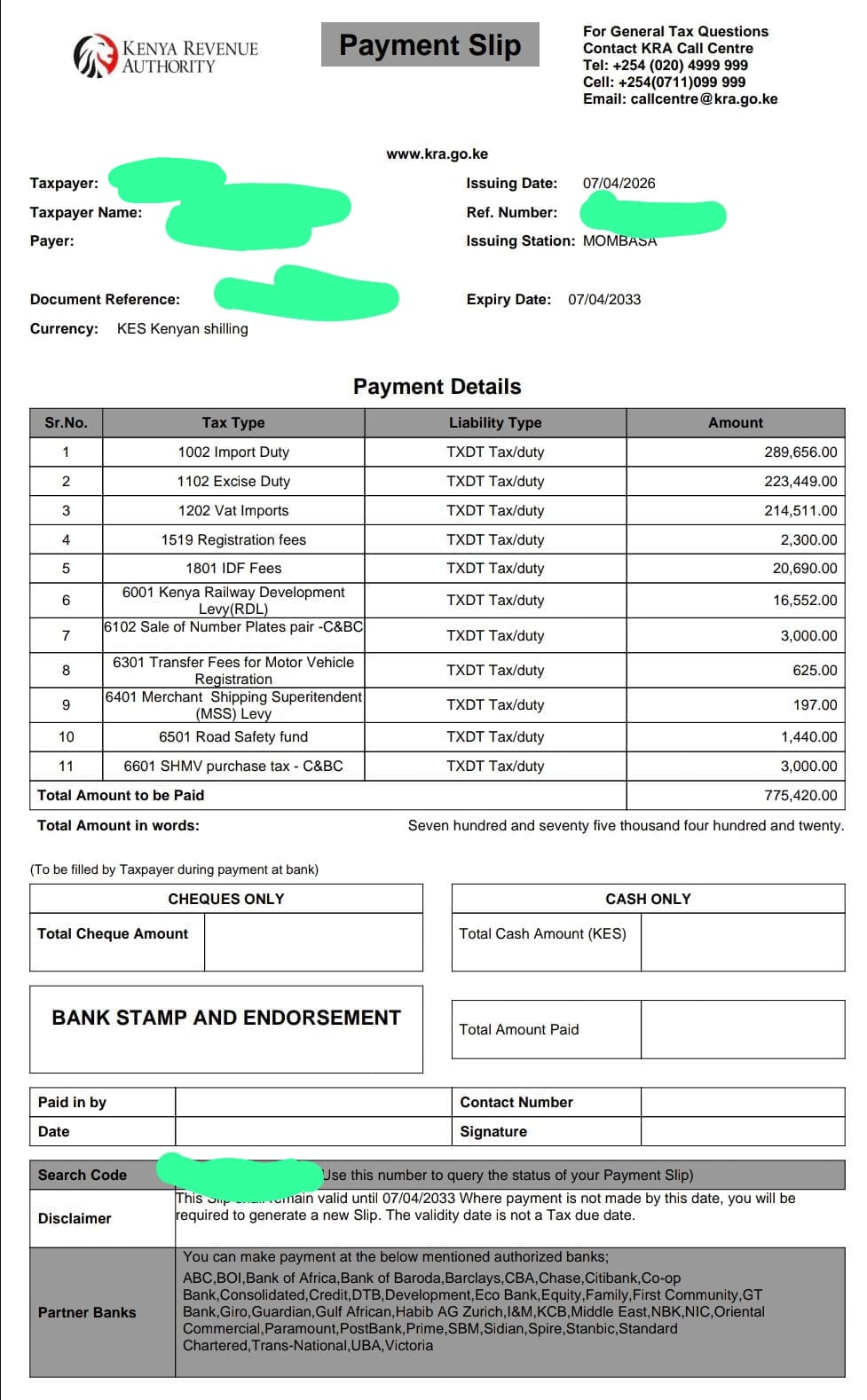
It looks complicated, right?
Yes!
Let’s walk through the main parts:
Import Duty — Usually the First Major Charge
This is typically 25% of the customs value(CRSP value).
This is the basic tax applied to most imported vehicles(save for tax exempted people)
It’s usually the first large number you’ll see on the breakdown.
Excise Duty — Depends on Engine Size and other factors
This one varies.
It’s influenced by:
- Engine capacity
- Fuel type
- Vehicle category
So, a small-engine(1500CC) car may attract less excise duty than a large engine car of the same type(2000CC).
This is one of the reasons why two similar cars can have different tax totals.
VAT — The One That Adds Up Quickly
VAT is currently 16%.
But here’s the important part:
It’s calculated after other taxes are added. Unfair again, right?
So it stacks on top of:
- Customs value
- Import duty
- Excise duty
Extremely unfair!
That’s why VAT often feels surprisingly high.
IDF and RDL — The Smaller but Important Charges
These are:
- Import Declaration Fee (IDF) — about 3.5%
- Railway Development Levy (RDL) — about 2%
They’re smaller than the others, but still part of the total.
And others
A real example!
We recently imported a 2020 Mazda CX3(1500CC) of gasoline(call it petrol) engine.
Its CNF(Car cost and Freight charges) value was KES 1500000.
The sample above was the customs quote the client received from KRA after the recently reviewed CRSP - a whooping 775k.
The initial estimate was KES 600k
this is totally out of our control but we strive to advise and guide our clients based on the latest rulings and valuations
Enough about unfairness
How Do You Actually Pay Customs?
Once the eSlip is issued, paying customs is straightforward.
Please don’t go to the port or KRA offices — pay through your bank.
Here are the common ways people pay:
Option 1 — Paying Through the Bank (Most Common)
This is the method many clients use.
You simply:
- Take your eSlip to your bank
- Provide the Reference Number(or just share the eSlip)
- Confirm the payment amount
- Make the payment
- Keep the receipt
That’s it.
Simple and reliable.
Option 2 - Paying Using Internet Banking or mobile banking
It’s 2026! Who wants to queue? The banks don’t even have toilets for their customers! Shame!
But this depends on your bank. Please confirm with them if they offer this option. You can reach out to their customer care.
Well I cannot provide a clear step to step guide because this depends on the banking and how their customer journey looks like. Should be pretty simple
Small Mistake That Causes Big Delays
This one is worth mentioning because we see it happen.
On your eSlip, you’ll notice:
- Reference Number
- Document Reference Number
They look similar.
But always use the Reference Number
Using the wrong one can delay your clearance.
It’s a small detail — but an extremely important one.
Most clients aren’t worried about paying. Normally, they’re worried about paying and unfortunately something goes wrong.
That’s why we always advise:
- Double-check the reference number
- Confirm the amount
- Save your receipt
- Share confirmation with us
Those small steps prevent unnecessary stress and delays.
What Happens After You Pay?
Once payment is made, KRA system updates. Most commercial banks in Kenya directly integrate with KRA systems.
The payment should reflect immediately or within 24 hours.
Clearance will now proceed smoothly.
Why We Always Explain This Step Clearly
Customs payment is one of the most sensitive parts of the import process.
Not because it’s complicated, but because it involves a large sum of money.
At Kalida Motors, we believe clients should never feel confused about what they’re paying.
You should understand:
- What the taxes mean
- How they were calculated
- How to pay correctly
That clarity removes fear and keeps the process smooth.
If You’re Approaching this Stage, if your vehicle is nearing arrival, this is a good time to:
- Review your expected tax estimate
- Prepare funds early
- Confirm your payment method
That way, when the eSlip arrives, you’re ready — not rushing.
Happy importing!
Your trust-first, transparent car import expert
Tom.